On monday we’re going to be giving another (40 minutes away) dojo a little visit, for which one of their dojo’s “sponsor” 7th dan sensei will be coming down from the capital and I thoroughly enjoy that sensei’s teaching style.

Encouraging, always a good word, on point analysis and asks you to give the max and beyond. I’ll take some pictures 🙂

Warm days bring almost empty dojos. But we still worked hard.
3 present : two 1 dan practitioners and me.

Training session :

Warmup : ±5′

Men Kirikaeshi (6-8 rotations)

Endurance training ±30′
On the length of the dojo, big techniques 
:

Oikomi geiko (only men throughout the dojo) 4 rotations of 2 dojo lengths each
Oikomi geiko (first strike kote, then men throughout) 4×2 dojo lengths
Oikomi geiko (first strike kote, then men with last strike dô) 4×2 dojo lengths
Oikomi geiko (kote men dô, kote men dô, kote men dô) 4×2 dojo lengths
Oikomi geiko (kote men dô men men, kote men dô men men) 4×2 dojo lengths

3 way infinite kihon men (issoku ittô no maai kara) with focus on left calf power, left ankle movement, buttox and abs contraction + arm relaxation, finger snap, correct men-landing and sound + strong kiai and zanshin acceleration.

Waza geiko : types of seme and harai techniques (omote and ura). 25-30′

Sliding towards throat (standard) and lower seme (with seme ashi or in one step strike) towards tsuba, small technique either left/ura (kote-men) or right/omote (men) depending on motodachi’s position.

Variations including reactions of motodachi (against hard kamae, weak kamae)

Jigeiko to test it out.

Question from practitioners : how to deal with kyusha kendoists who often don’t allow for the “kamae-dialog” construction by attacking inappropriately and/or constantly.

My answer : destroy their kamae, then hit big techniques, pressure them into making mistakes (opening men or kote). Hari techniques, small wrist pressuring osae movement forcing an improper-going-too-far “return to kamae” movement from opponent, thus opening their kote, etc

In other words : have a more dominant kendo, while working big and correct (the level difference should allow for a display of tadashii).

Jigeiko all together for the last 20 minutes of practice.
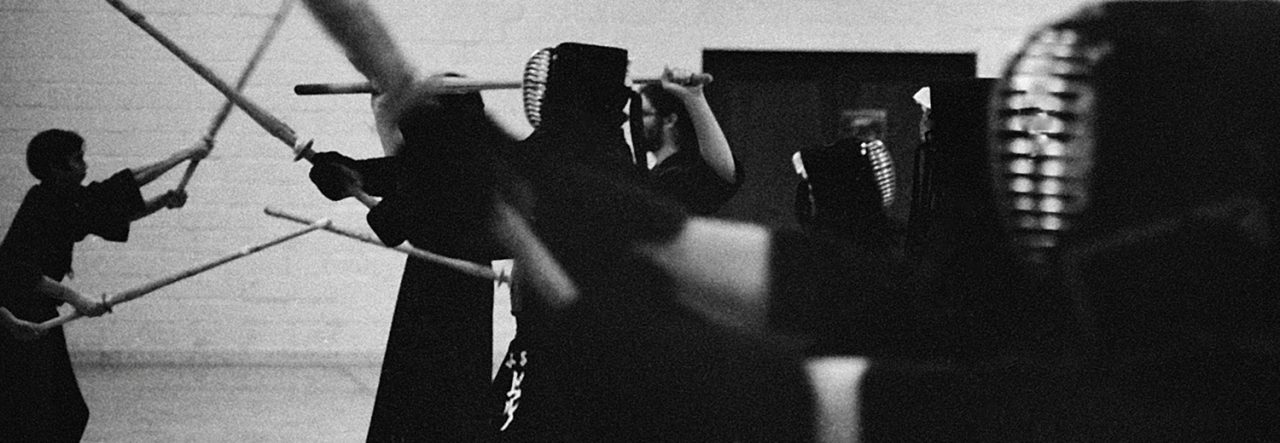
Reflecting on Nuke-tô

Nuke-tô, the act of drawing your sword, or in this case, shinai is a subject I would like to reflect on, and for which I would ask your opinion about as well.

I’ve been taught two conflicting ways of doing nuke-tô :

  1. Taking it out as it you shinai had a saya : 1/3 of the movement with the tsukagashira (pommel) towards your opponent’s chest in a resolute, earnest fashion
  2. Taking it out gently, making it rotate into kamae position as soon as your right hand grabs it

I’ve been told by some people (but not my sensei) that the first option it is seen as rude and too agressive, while my sensei, for my 3rd dan grading encouraged me to do it. “Show you’re here to do kendo, from the first step you take”.

I believe it is one of these questions that have different answers depending on how you envision kendo.

Since I’ve been 3rd dan I’ve completely changed my way of performing the salute, without guilt. I believe that when I get into sonkyo now, I’m non-verbally saying something like “I’m here, I’m eager, let’s practice together”.

What are your thoughts on this?

About the next step…

I’m in that area where I start understanding the effect of pressure on others and where I start seeing opportunities more clearly, especially, the moments I should move and the moments I shouldn’t. 

I’m starting to understand that always attacking like we’re taught in the first few years is not enough and that I’ll need to start being aware and take a better advantage of the action/reaction dynamics involved without sliding into defensive behaviour.

I’ll postulate that my next grading step next year — 4th dan — is about making this as natural as possible :

Pressure : kiai, kizeme, seme, reaction of partner, my reaction to their reaction, seizing the opportunity, putting them into one of the Shikai (aka four sicknesses of the mind) and being able to make my kendo shine through an overall attitude of “tadashii kendo” from the first ritsu rei (standing bow) to the last.

I’ve missed the championship following a nasty cut in the hand. 

I can’t train for two weeks, but I’m still leading the training sessions (and throw one-handed strikes here and there). Since I’m incapacitated, I can focus more on correcting our members. So all in all, it’s not that bad. 

There is a regional taikai in a month, hopefully my hand will be fully operational by that time.

The national dan championship draws near…

Like every year, I am forcing myself to take part. My sensei made it clear that it was not a good attitude to avoid going to shiai. But it’s hard on the ego especially since I’ve never landed a single ippon in shiai (despite being 3rd dan). It makes me think I must be one of the “weak” holders of a certain dan rank (as I have often overheard being uttered here and there).

Maybe it is because I never won a single point, let alone match that I’m saying this, but I have no interest in competition. I have no interest in facing others with a pressure to win anything. I find that kendo is very different without its competitive aspect, and I would welcome large jigeiko sessions instead of competitions.

I feel that my opinion is not mature enough though, so I’ll just stick to it until I finally get it, until I can play my usual kendo in shiai and make it work there.

I live in a place where we have access to a high concentration of high-ranking teachers, but where a 30km trip is considered “far” to do anything. My dojo was founded around that cultural trait.

“How come there is no kendo-dojo in a town and area of around 110.000 inhabitants, while there are dojos north, east and west but 50km away?” was the constatation that started it all.

For a couple of years, we had an instructor from another dojo, but we realised that we would have to become self-sufficient, sooner rather than later. After another year of hit-and-miss with help from the outside, we had to face it : we would have to take matters in our own hands, meaning that I would have to step up to the task.

This is the reality of the story of how a 1st dan started leading training sessions, though I know it is hard to hear or accept for anyone. Reading opinions on the internet sure didn’t help make me feel at ease with this daunting task.

Thankfully, we weren’t without support. A person I consider my sensei (though I don’t train with him regularly) has been helping us paving the way of correct practice for about 5 years now.

The dojo has been through difficult times, but necessary times. Times of searching, of self-definition. Going from having been handed down a strange point-of-view on kendo at our very beginnings to becoming too gentle after being left on our own.

It took a decade of existence to finally feel “on the right track” and now what we have to do is keep building our momentum.

Me in 2010 as I was brushing up on some iaido, outdoors.
I was 25. I am now 33.

I haven’t seriously practiced iaido since 2011 I believe, instead I have been focusing on kendo only, for several reasons.

The main one being that I was (and still am) the member with most seniority of my dojo which at the time was a mere 3 years old. I had to train harder, although mostly with my mind, or outside of the dojo, acquiring transversal skills (such as studying didactic), to help me succeed in this task as well as to remain a motivator for the others.

Some time has passed since. I am still the de facto dojo leader but am now entering my 3rd year of 3rd dan. Still a beginner, but becoming a decent beginner.

This blog is the story of how I try to reconcile being a humble student on the way of the sword with having been a dojo-leader since I’ve been first dan.

I now dare writing about it because the years of experience are slowly piling up and I’ve managed to keep a level head for almost a decade. I know that I’m still leagues from being a dojo-leader that can be taken seriously, but I’m getting there and start to feel legitimate in this position I didn’t ask for.

Welcome.