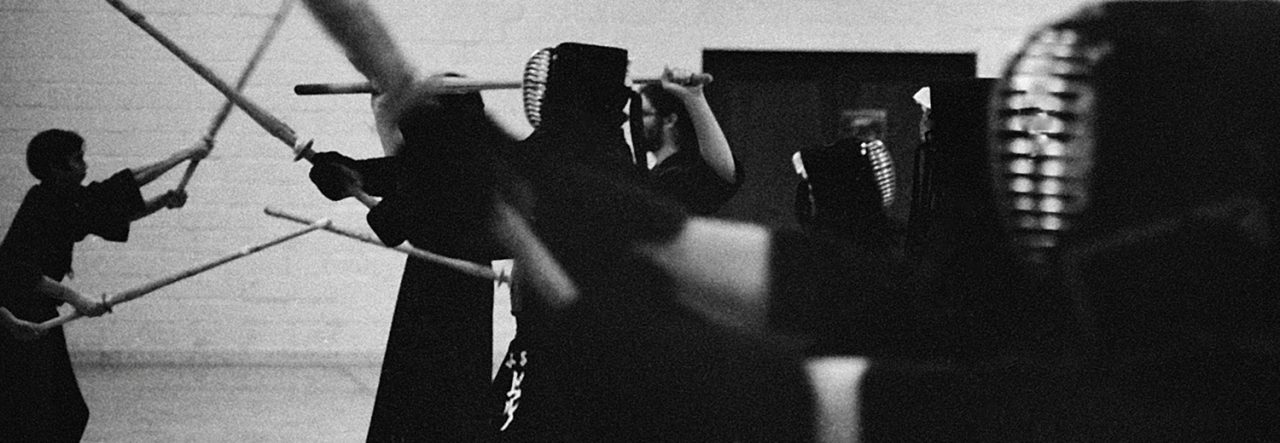
One sensei, or three — or why I don’t feel guilty about shuffling.

I’m in a particularly weird situation : no sensei present at my dojo, but I am dojo leader. Though there is one 50km away that I consider my sensei, that I don’t see often but whose advice I follow eagerly.

Plus two other, same 7th dan rank, same generation sensei who have different teaching styles and will bring perspective on my auto-evaluation, as other input sources.

The catch : all three of them have the same Japanese hachi-dan sensei and are good friends, so basically, I consider this maximising my angles of approach of the same core principles. Obviously they are different from each other as human beings but the source material (their sensei) makes sure I’m basically learning the same kendo.

Sometimes, I may feel that one sensei is going to be best for putting me on the right track, depending on the difficulties I face while if I limited myself to just one, I might find myself going in circles more.

I know my place well and embrace it. I’m a dojo leader but not a sensei. I’m willing to learn to be able to pull my group in the right direction, not to make myself important. and I shuffle between those three sensei that I appreciate greatly, not because I don’t like when I hear their criticism (and sometimes admonishing) but because I want a bigger and clearer, more diverse picture of where I stand in kendo.

I really think that both this and having been a dojo leader for so long (since my first dan) wouldn’t have been possible without a solid decade of beforehand martial arts training, through which my ego has been somewhat tamed.

Without a mind already moulded by practice, I would probably have lost myself on an ego trip, I’m pretty sure of that.

So with this post, and against all your expectations, dear reader, I would like to thank my fencing Maître d’Armes and my Karate Sensei for dealing with, respectively, the impatient adolescent and later the superficial young man that I once was.

They helped me root out all sorts of flaws of character and I am truly, humbly grateful for it. The sad thing is that I lost contact with both of them. I tried to send a letter to my karate sensei around 2011 but it came back “unknown at this address”.

I fear the worst.

I think my Maître d’Armes is still around though, but he’d be well into his nineties by now.

I fear the worst.

I should try and get in touch.


Wow, this post has a twist that I didn’t anticipate when I started writing it…

tumblr_inline_phht60S37k1vew5ck_1280

Left : me aged 13. I practiced fencing from 1997 to 2001, from 12 to 16. Right : Maître d’Armes Fernand Briot after his last training, we did a honour guard to celebrate.


tumblr_inline_phht60QOuA1vew5ck_1280

Left : the karate dojo before practice. Right : my Karate Shotokan instructor from 2001 to 2006, Alex Guiot-sensei who liked to incorporate jiujitsu and aikido techniques around a strong shotokan core. I practiced another year and a half in a couple other dojos after his closed down. I never could find elsewhere what I liked at the zanshin no michi dojo.

In 2005 I practiced kendo and iaido for a year in another town 40 kilometres away and had to stop because I was a student and moving around proved impractical. When my current dojo opened in my home town at the end of 2009, I joined immediately!

We have started the tenth year of existence of this kendo dojo and I have now begun my 11th year of kendo. I hope there are plenty more years that will follow and plenty more sensei to guide me along the way, and perhaps not only in matters pertaining to kendo, but also about life in general.

*raises  glass*
Here is to all the giants whose shoulders we’ve been invited to stand upon.

A few weeks back, I sent Andy Fisher a few questions for his Kendo Rant bit on his Facebook and youtube channels. I expected the answers I got although it drew my attention on a number of things I hadn’t considered long enough, somewhat mitigating my views.

I still feel like I need time to consider all the points of the arguments I made. What my position was before I started asking around, take into account the process I’ve been through and where my opinion is at now.

But before I write articles about some of these issues, I’d like to start structuring those ideas, maybe simply with a small list to which you may react and give your two cents, as I am still letting my ideas mature before I write a proper article about those subjects.

About Shiai :

  • Kendo and competition go hand in hand, the match is the test of skill
  • But the only ones really doing competition in Japan are kids, students and professional players. Most of them don’t start willingly. They don’t have a choice in the matter. While “hobby” kendoists starting at say 25-30 years of age, follow a different path and are not really pushed to participate.
  • Participating only sporadically to such events seems to me, to be more in line with the self-development aspect of kendo.
  • Some people say it’s vital to participate but some discourage it (to each their own then?)
  • Outside Japan (with maybe the exception of Korea) isn’t this “you must participate” argument coming from the higher ranks more about making the small regional/national federations thrive and that might actually be the more important reason for participating to the taikai? In which case, should it not be presented that way, outright?
  • Could there be other events in which shiaigeiko is performed, without the daunting aspect of driving far to only participate in a couple of matches, which is an aspect of shiai that is hardest on hobby-kendoists?
  • Andy’s “it is what it is, you gotta stick with it” answer feels somehow unsatisfactory but, coming from a national team captain, it was expected. But then this might simply mean that I’m free to make my own choice on the matter and I shouldn’t be afraid of anyone’s opinion.

About violent behaviour in Kendo :

  • Andy’s answer is clear and I am 100% behind it : anyone who does kendo to rough up others to make themselves feel better / more powerful is doing it wrong.
  • Apparently Andy’s never witnessed any case of abuse of power in his kendo practice and that is encouraging because that means I might have had just a lot of bad luck and then it helps me paint another picture of the practice. But looking around me and seeing some people who love to affirm themselves through the roughing of others and some holding lists of who they manage to throw on the ground during shiai, as a sort of “fun” trophy… well… ouch.
  • What I was alluding to in my question was such cases as the dangerous over-the-shoulder judo technique that happened a few years back in an international level championship. Andy didn’t really understand it that way and I guess I wasn’t clear enough. But here, I’ll address the elephant in the room : why aren’t rules changed so that such behaviour is met with instant DQ from the event plus recommendation from FIK or EKF to the person’s national federation for a permanent ban or membership suspension?
  • Why does it look like the various federations don’t care about this at all? Some form of communication from the federations to the members at large would help loads to clarify at least their position on the matter (for instance a couple of lines in the shiai description documents).
  • Their silence seems like tacit approval and I think, as a federation, you don’t want that.
  • The problem is that if I do kendo, I will expect for a certain number of things to happen as part of the practice but I will also never expect to suffer dangerous moves (that could end up in injuries or fatalities) because they are not part of the conventional practice.
  • Illegal move + putting your opponent’s safety at risk : doesn’t it warrant a very firm reaction from the shinpan and event organiser than just a hansoku and maybe a little informal talk on the sidelines?