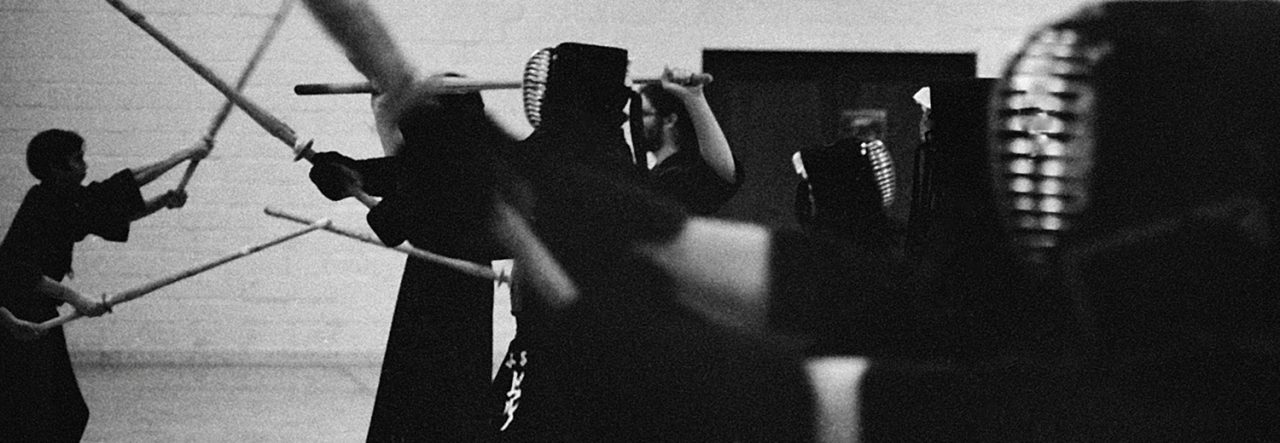

I gave my little idea a try (basing a lesson on jigeiko observations) and it certainly can prove useful, especially when the group is homogenous vis-à-vis the rank level.
After the first rounds of jigeiko, I asked what were their difficulties and few problems were noted :
- Distance problem : feeling of not being where they should be
- Linked to that : difficulty of withdrawing from chikama properly, or not wanting to withdraw for fear of being hit.
- Problems dealing with opponents who are blocking too much
My own observations were that the few first jigeiko bouts were fine but quickly got twisted by “I don’t want to get hit” thoughts, resulting in bad form and general tenseness.
The first concept I tackled was about withdrawing from an unsuccessful attack or unsuccessful seme. It was apparent that their thoughts when going backwards were not focused on the opponent and were neither thinking about attacking nor being ready to react to being attacked.
The drill I asked them to do to foster correct withdrawing :
- Kakarite : Men, tai atari and goes into tsubazeriai.
- Both : withdraw carefully, tip in the center, focused but without being tense in their bodies or kamae
- Motodachi : suddenly attacks men once issoku itto no maai is reached
- Kakarite : Performs oji-waza of their choosing (or debana waza)
Although ideally, once both practitioners start to withdraw, they should return to to-ma, you have to learn to expect attacks and also be able to seize opportunities. The goal of this drill is to feel confident enough to retreat with correct zanshin and attitude while also developing the ability to spot weaknesses and exploit them.
The difficulties they faced during this drill was that they had a hard time withdrawing in a relaxed natural manner knowing they had to attack or were about to be attacked. Some timing was off also (kakarite would counter-attack before motodachi’s move), because of the anticipation.
I remember trying to convey the idea that one should be relaxed at all times while also being ready at all times. Initiating waza should be done only when there is opportunity (in this case, when motodachi starts their attack).
Drills to deal with blockers :
- Kakarite : seme towards men
- Motodachi : raises arms and protects their men
- Kakarite : attacks kote
- Kakarite : seme towards men
- Motodachi : sanpo mamori (protecting men, kote and migi-do)
- Kakarite : responds with gyaku (hidari) do.
All of this has to infuse into their kendo, it will require time, but definitely brains seemed to have been working hard during this training session.
Before wrapping up, I reminded them of how kyusha are asked to perform shikake waza mindlessly to allow their bodies to acquire correct moves. The phase they are in as 1st/2nd dan means they have to start thinking and observing what is going on and learn to recognise opportunities to start seizing them by selecting the correct answer in their kendo vocabularies, which they need to build up, as well.
“And that’s the plan for the coming year!”

 Gentle Kendoist : A Diary